AI-Designed Peptides and Enzymes: What Lab Tests Show
News
Designed proteases cut amyloid-beta and TDP-43 in vitro and a designed peptide tracer imaged tumours in mice — all preclinical, with modest hit rates.
Computational design has moved from predicting what peptides and proteins look like to generating new ones that measurably work in a test tube. In the past year, designed zinc-dependent enzymes cleaved disease-associated proteins including TDP-43 and amyloid-β at targeted sites [1], and a computationally designed peptide, radiolabelled as an imaging probe, accumulated in tumours in mice [3]. None of this has been tested in humans, and the success rates reported in these papers make clear that design is still a numbers game.
Key takeaways
- In one design campaign, 36% of 135 tested protein designs cleaved their intended peptide substrate at the targeted bond; the best designs reached rate accelerations above 10⁸- to 10¹⁰-fold over the uncatalysed reaction [1].
- Designed proteases were reported to selectively cleave human disease-associated proteins — TDP-43, amyloid-β and serum amyloid A — in laboratory assays, with rate enhancements up to 10⁹-fold [1]. This is biochemistry, not a demonstrated effect on disease.
- An AI-designed peptide conjugated to a chelator and labelled with gallium-68 bound TROP-2 with nanomolar affinity and imaged TROP-2-positive tumours in mouse xenograft models [3].
- Computational screens generate far more candidates than confirmed hits: in one protozoan proteome screen, three predicted antimicrobial peptides were synthesised and only one inhibited Escherichia coli growth in vitro [4].
Designed enzymes that cut peptide bonds
Designing an enzyme that breaks an amide bond from scratch has been a long-standing problem in protein engineering [1]. A 2026 paper in Nature used deep-learning-based protein generation to build proteins with a water-activating zinc active site positioned next to a pocket that binds a chosen peptide [1]. The logic is modular: the pocket decides which sequence is recognised, the metal centre does the chemistry.
Of 135 designs that were expressed and assayed, 36% cleaved their intended peptide substrate at the targeted scissile bond [1]. The best design sped up peptide-bond hydrolysis by more than 10⁸-fold compared with the uncatalysed reaction, and four amino-acid substitutions pushed that past 10¹⁰-fold — an improvement the authors attribute to better pre-organisation of the active site [1].
The authors then retargeted the same approach at human proteins linked to disease: TDP-43 (associated with ALS and frontotemporal dementia), amyloid-β, and serum amyloid A, reporting selective cleavage with rate enhancements up to 10⁹-fold [1]. They also built cytokines and receptor antagonists in a “caged” form that only becomes active when the matching designed protease cuts them, which let them switch cell states on demand in culture [1].
Limits matter here. These are in vitro and cell-based experiments on purified or recombinant substrates; the paper describes applications in therapeutics, biotechnology and bioremediation as prospects, not results [1]. Cleaving amyloid-β or TDP-43 in a tube says nothing about whether doing so in a living brain would help, harm, or do nothing — and nothing about delivery, immune responses to a non-natural protein, or off-target cutting of the proteome. Roughly two thirds of the designs also failed outright [1], which is the honest baseline for how reliable current design methods are.
A designed peptide tracer that imaged tumours in mice
TROP-2 is a cell-surface glycoprotein that is overexpressed in several epithelial cancers, and assessing it clinically still generally means taking a biopsy and staining the tissue [3]. A 2026 study in Bioconjugate Chemistry used an AI platform to design a TROP-2-binding peptide by mimicking the interface a natural binding partner uses, then attached a DOTA chelator and labelled it with gallium-68 to make a PET probe [3].
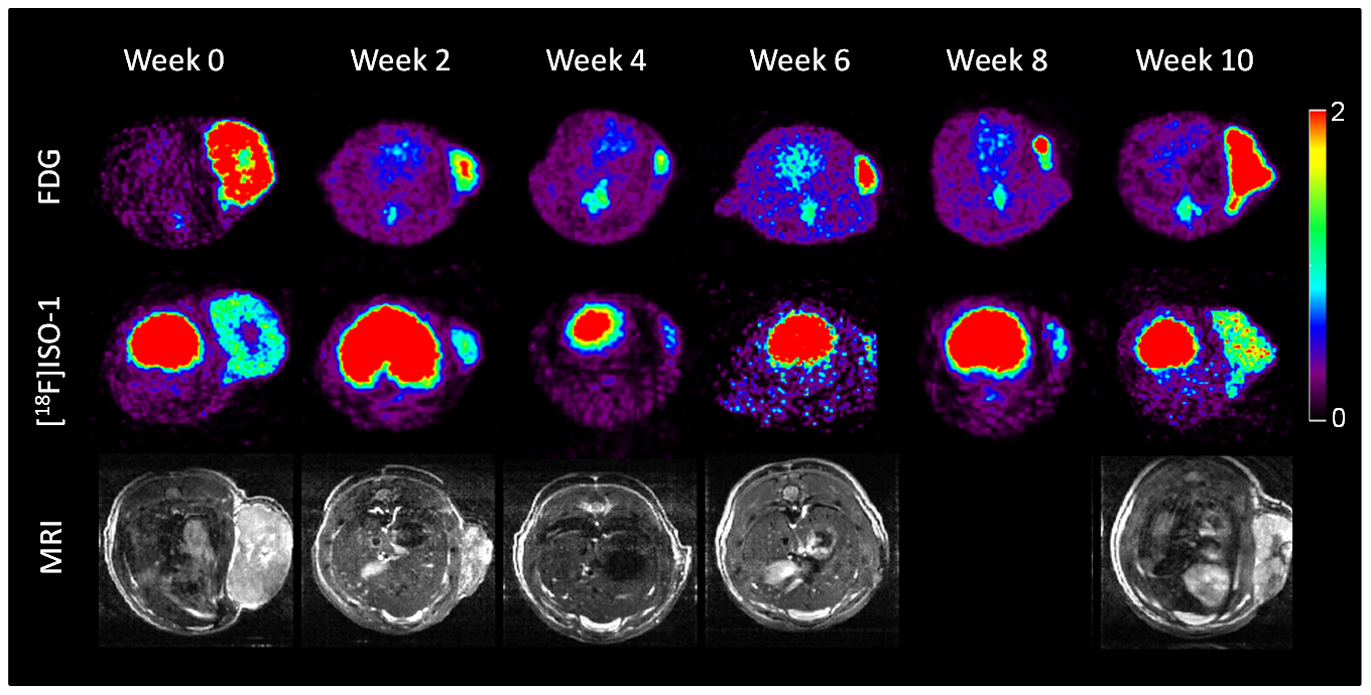
The reported characterisation is fairly complete for a preclinical tracer: nanomolar affinity for TROP-2 (Kᴅ = 26.8 nM), selective uptake in TROP-2-positive cells, radiochemical purity above 95%, and stability in saline and serum [3]. Micro-PET/CT in pancreatic, prostate and thyroid xenograft mouse models showed rapid tumour accumulation with high contrast and low background [3]. Giving excess unlabelled peptide first substantially reduced tumour signal, which is the standard way to show the uptake is receptor-mediated rather than non-specific [3]. Quantified tumour uptake (SUVmax) correlated positively with TROP-2 levels measured by immunohistochemistry across all three tumour types [3].
The constraints are the usual ones for xenograft imaging work: immunodeficient mice carrying human tumour implants are a simplified model of human cancer, the sample sizes per model are not given in the abstract, and the paper itself frames the tracer as having “translational potential” rather than established clinical performance [3]. Human studies would need to address dosimetry, background in organs that express TROP-2 normally, and whether the correlation with expression holds in real tumours.
Screening proteomes for antimicrobial peptides
A different use of machine learning is mining existing sequences rather than inventing new ones. A 2026 study in the Journal of Parasitology applied a deep-learning classifier to the proteomes of five protozoa — Blastocystis hominis, Trypanosoma cruzi, Leishmania major, Toxoplasma gondii and Entamoeba histolytica — looking for antimicrobial peptide candidates with prediction probabilities above 0.90 [4].
The screen returned 48 candidates in B. hominis, 27 in T. cruzi, 23 in T. gondii and 24 in E. histolytica, and none above threshold in L. major [4]. Candidates came from varied protein classes, including ribosomal proteins, enzymes and membrane-associated proteins [4]. Three were synthesised and tested against E. coli K12: one, derived from a 60S ribosomal protein, inhibited growth with a minimum inhibitory concentration of 125 μM, while the other two showed no detectable activity [4].
One hit in three, at a fairly high concentration, against a single laboratory strain of one bacterium. The authors present this as evidence that deep learning is useful for prioritising candidates and as a reminder that experimental validation is indispensable [4] — a framing consistent with a broader 2026 review in Annual Review of Microbiology, which surveys activity prediction, structure-activity modelling, sequence optimisation and de novo generation, and argues the field’s progress depends on workflows that couple in-silico design tightly to high-throughput testing [2]. That review also describes “encrypted immunity”: the idea that ordinary proteins carry latent antimicrobial fragments that mining can surface [2]. It is a review, so it synthesises published work rather than reporting new experiments, and it lists remaining obstacles on the path to the clinic alongside the opportunities [2].
Designing recognition of peptide–HLA complexes
A fourth strand concerns peptides as targets rather than drugs. Most mutated proteins that distinguish a tumour sit inside the cell, out of reach of conventional antibodies; what is exposed is the mutation-derived peptide presented on cell-surface HLA [5]. A 2026 review in npj Drug Discovery examines single-chain variable fragments engineered to recognise those peptide–HLA complexes the way a T-cell receptor would [5].
The review is useful mainly because it insists on separating three questions that often get blurred: which mutations are predicted to be presented, which presented complexes are actually targetable given how few copies sit on the surface and how much cross-reactivity risk they carry, and how immunogenic the engineered molecule itself will be [5]. It covers computational target identification, AI structure prediction, de novo design, affinity and specificity engineering, half-life extension and deimmunisation, and distinguishes the binding module from the effector format it is eventually built into [5]. As a review, it reports no new results.
What we still don’t know
Everything above is preclinical. No study here involved human participants [1, 3, 4], and two of the five sources are reviews rather than primary experiments [2, 5].
Specific gaps: whether designed proteases retain selectivity in the complex protein environment of a living organism, and what cleaving abundant proteins such as amyloid-β or serum amyloid A would actually do physiologically, are untested — the Nature work stops at biochemical and cell-level demonstrations [1]. Whether the TROP-2 tracer’s tumour contrast and expression correlation carry over from xenograft mice to human tumours is unknown [3]. Whether any AI-identified antimicrobial peptide is active against clinically relevant resistant pathogens, at concentrations that are tolerable, and in anything more complex than a broth assay remains open [2, 4]. For peptide–HLA-directed binders, the surface-density and cross-reactivity problems are described as unresolved design constraints, not solved ones [5].
It is also worth noting what the hit rates imply. A 36% success rate on a designed enzyme [1] is remarkable by historical standards and still means most designs fail; a one-in-three validation rate on synthesised antimicrobial candidates [4] means prediction scores are a filter, not an answer. The tools are getting better at proposing molecules worth making. Deciding whether those molecules do anything useful in a person is still a long, separate process.
References
- Computational design of metalloproteases. Nature (2026). doi:10.1038/s41586-026-11167-2
- Computational Peptide Design: Emerging Concepts in Antibiotics, Immunity, and Evolution. Annual Review of Microbiology (2026). doi:10.1146/annurev-micro-042524-035131
- De Novo Design of a TROP-2-Targeting Peptide PET Tracer via AI-Guided Binding Interface Mimicry. Bioconjugate Chemistry (2026). doi:10.1021/acs.bioconjchem.6c00394
- Deep Learning Prediction of Antimicrobial Peptides in Protozoa. Journal of Parasitology (2026). doi:10.1645/25-99
- Computational design and translational development of TCR-mimic scFv antibodies for peptide-HLA neoantigen targeting. npj Drug Discovery (2026). doi:10.1038/s44386-026-00084-z
Image credits
Free to use (CC0 / public domain); credited as a courtesy.

