Liraglutide in the real world: new data on mood, thyroid and heart
News · Liraglutide
Five new papers examine liraglutide and related GLP-1 drugs outside their trials: veterans' heart outcomes, mood, rat thyroid tumors and off-label prescribing.
GLP-1 receptor agonists such as liraglutide are now prescribed far beyond the populations in their original trials, and new studies are testing whether trial results and safety concerns carry over [1, 4]. A cluster of 2026 papers looks at four of these questions: heart outcomes in US veterans, links with mood problems, the meaning of rat thyroid tumors, and prescribing without an approved indication [1, 2, 3, 4]. None of them settles its question, but together they show where the evidence is firm and where it is thin.
Key takeaways
- A statistical reanalysis that reweighted the LEADER trial to resemble US veterans estimated a heart and mortality effect for liraglutide that was larger than in the trial, though statistically consistent with it [1].
- A systematic review of 14 studies found no consistent increase in depression, anxiety or suicide-related outcomes with GLP-1 drugs, but rated the certainty of that evidence low or very low [2].
- A regulatory analysis concluded that thyroid C-cell tumors in rats arise through a mechanism its authors judge irrelevant to humans; the drugs still carry a boxed warning for medullary thyroid carcinoma [3].
- Prescribing of GLP-1 drugs to US adults without an apparent approved indication rose about 15-fold from 2021 to 2025, and about a third of those recipients had a normal BMI [4].
Does the heart trial result hold for veterans?
LEADER was a placebo-controlled randomized trial of liraglutide that measured cardiovascular outcomes in people with type 2 diabetes [1]. Trial participants often differ from the patients who later receive a drug, so a new study asked how LEADER’s result might translate to veterans in the Veterans Affairs (VA) healthcare system, a high-risk group the authors describe as underrepresented in such trials [1].
This was a “transportability” analysis, not a new trial [1]. The researchers reweighted LEADER participants so their baseline characteristics matched real-world VA cohorts, then re-estimated the trial’s treatment effect for that reweighted population using a statistical method called augmented inverse probability weighting [1].
The results were expressed as risk differences at 3 years between liraglutide and placebo [1]:
- Major adverse cardiovascular events (MACE): 4.6 percentage points (95% CI 2.2 to 7.0) in the VA-weighted analysis, versus 1.6 points (0.3 to 2.9) in LEADER itself [1].
- Death from any cause: 2.9 points (0.8 to 5.1) in the VA-weighted analysis, versus 0.9 points (-0.09 to 1.9) in LEADER [1].
The authors describe the veteran estimates as larger than, but statistically consistent with, the original trial [1]. Note that the original LEADER confidence interval for all-cause mortality in this analysis includes zero [1].
Limits: Transportability methods can only adjust for characteristics that were measured in both the trial and the target population; anything unmeasured that changes how the drug works is not captured. The estimates still rest on LEADER’s randomized data rather than on veterans who actually received liraglutide, and the wide intervals mean the true size of the effect in veterans is uncertain [1].
Are GLP-1 drugs linked to mood problems?
Reports of depression, anxiety and suicidal thoughts have raised questions about this drug class [2]. A systematic review searched three databases following PRISMA 2020 guidelines for studies of adults with overweight or obesity [2]. It included 14 studies: four randomized studies, nine longitudinal observational studies and one cross-sectional study [2].
The randomized studies showed no consistent worsening of depressive symptoms, and suicidal ideation or behavior was uncommon in them, without a consistent imbalance between groups [2]. Observational studies pointed in different directions: hazard ratios for depression ranged from 0.63 to 2.95, and for suicide-related outcomes from 0.27 to 2.06, depending on the population and comparison group [2]. Anxiety findings were also mixed, and manic or hypomanic symptoms were not systematically assessed [2].
The authors concluded that current evidence does not show a consistent increase in adverse neuropsychiatric outcomes [2]. They rated certainty as low for depressive symptoms and very low for anxiety and suicide-related outcomes [2].
Limits: The review covers GLP-1 drugs as a class, not liraglutide alone, and the authors caution that individual drugs may differ [2]. Because the studies varied so much, results were summarized narratively rather than pooled [2]. The authors state the findings do not establish class-wide neuropsychiatric safety, and call for studies designed for this question, including people with existing psychiatric conditions [2].
Do rat thyroid tumors matter for people?
Long-term studies in rodents have consistently shown more thyroid C-cell tumors with GLP-1 drugs, which led to a boxed warning for medullary thyroid carcinoma [3]. The open question is whether those rodent findings apply to humans, given species differences in how the GLP-1 receptor works [3].
A new paper applied a regulatory weight-of-evidence framework, from the international ICH S1B(R1) guideline, to seven approved GLP-1 drugs: lixisenatide, exenatide, liraglutide, dulaglutide, semaglutide, tirzepatide and albiglutide [3]. The framework is meant to judge whether 2-year rat cancer studies add value for assessing human cancer risk [3].
Across all six areas of evidence in the framework, the authors concluded that these drugs cause tumors in rats through a known mechanism that is not relevant to humans [3]. On that basis, they argue that further 2-year rat studies are unlikely to help regulators decide about this drug class [3].
Limits: This is an analysis of existing evidence, not a new animal or human study [3]. Its conclusion is about the value of future rat testing for regulatory decisions; it is not a human safety study, and the boxed warning described in the paper remains in place [3]. Rodent findings, in either direction, cannot be read as direct evidence about cancer risk in people.
How often are these drugs prescribed without an approved indication?
A retrospective cohort study used US electronic health records from January 2021 to December 2025 to look at adults prescribed liraglutide, semaglutide or tirzepatide without a documented approved indication (type 2 diabetes, or obesity with qualifying conditions) [4]. People without a weight recorded at least six months before their first prescription were excluded [4].
Among 92,415,648 adults without an apparent approved indication, 1,133,953 (1.2%) received a GLP-1 drug prescription [4]. That share rose from 0.1% in 2021 to 1.5% in 2025, about 15-fold [4]. Recipients were more often female (85.5%) and White (60.0%), and had a higher median BMI than non-recipients (25.9 vs 24.5) [4]. About 35.1% had a normal BMI, and eating disorders were more common among recipients (1.8% vs 0.3%) [4]. Prescribing was associated with lower social vulnerability and with private insurance [4].
Limits: “Without an apparent indication” means no qualifying diagnosis was recorded; health records can miss diagnoses, so some prescriptions may have had an indication that was not documented [4]. The study describes who received prescriptions, not what happened to them, and the authors note that the risk-benefit balance in these groups remains uncertain [4]. It also pools three drugs rather than isolating liraglutide [4].
Early signals from case reports
A separate report described two patients with skin reactions after starting a GLP-1 drug [5]. One, relevant to liraglutide, had a return of solar urticaria (a sun-triggered hives condition) five days after starting liraglutide, after more than 20 years in remission; it persisted after the drug was stopped [5]. The other developed skin sarcoidosis after starting semaglutide, which resolved when it was stopped [5]. A standard causality score rated both as probable drug reactions [5].
Limits: Two case reports cannot show that a drug causes a reaction or how often it happens; they flag possibilities for further study [5].
What we still don’t know
- Whether the larger heart and survival effect estimated for veterans would appear in a study of veterans actually treated with liraglutide, and how unmeasured differences might shift it [1].
- Whether individual GLP-1 drugs, including liraglutide, differ in neuropsychiatric effects, and how they affect people with existing psychiatric conditions [2].
- How regulators will weigh the argument that rat thyroid tumors are not relevant to humans, and what long-term human data show [3].
- What benefits and harms GLP-1 drugs carry for people without an approved indication, including those with a normal BMI or an eating disorder [4].
- Whether rare skin reactions like those in the case reports represent a real pattern [5].
References
- Real-world cardiovascular effects of liraglutide: transportability analysis of the LEADER trial. American Journal of Epidemiology (2026). doi:10.1093/aje/kwag236
- Neuropsychiatric Outcomes Associated with GLP-1 Receptor Agonists in Adults with Overweight or Obesity: A Systematic Review. Brain Sciences (2026). doi:10.3390/brainsci16090926
- Suitability of the ICH S1B(R1) weight-of-evidence framework to evaluate glucagon-like protein-1 receptor agonist (GLP-1RA) carcinogenicity risk. Regulatory Toxicology and Pharmacology (2027). doi:10.1016/j.yrtph.2026.106252
- Trends in GLP ‐1 Receptor Agonist Prescribing Without an Apparent FDA ‐Approved Indication. Obesity (2026). doi:10.1002/oby.70301
- Novel cutaneous adverse effects of the increasingly prevalent glucagon-like peptide 1 agonists. Skin Health and Disease (2026). doi:10.1093/skinhd/vzag090
Image credits
Free to use (CC0 / public domain); credited as a courtesy.
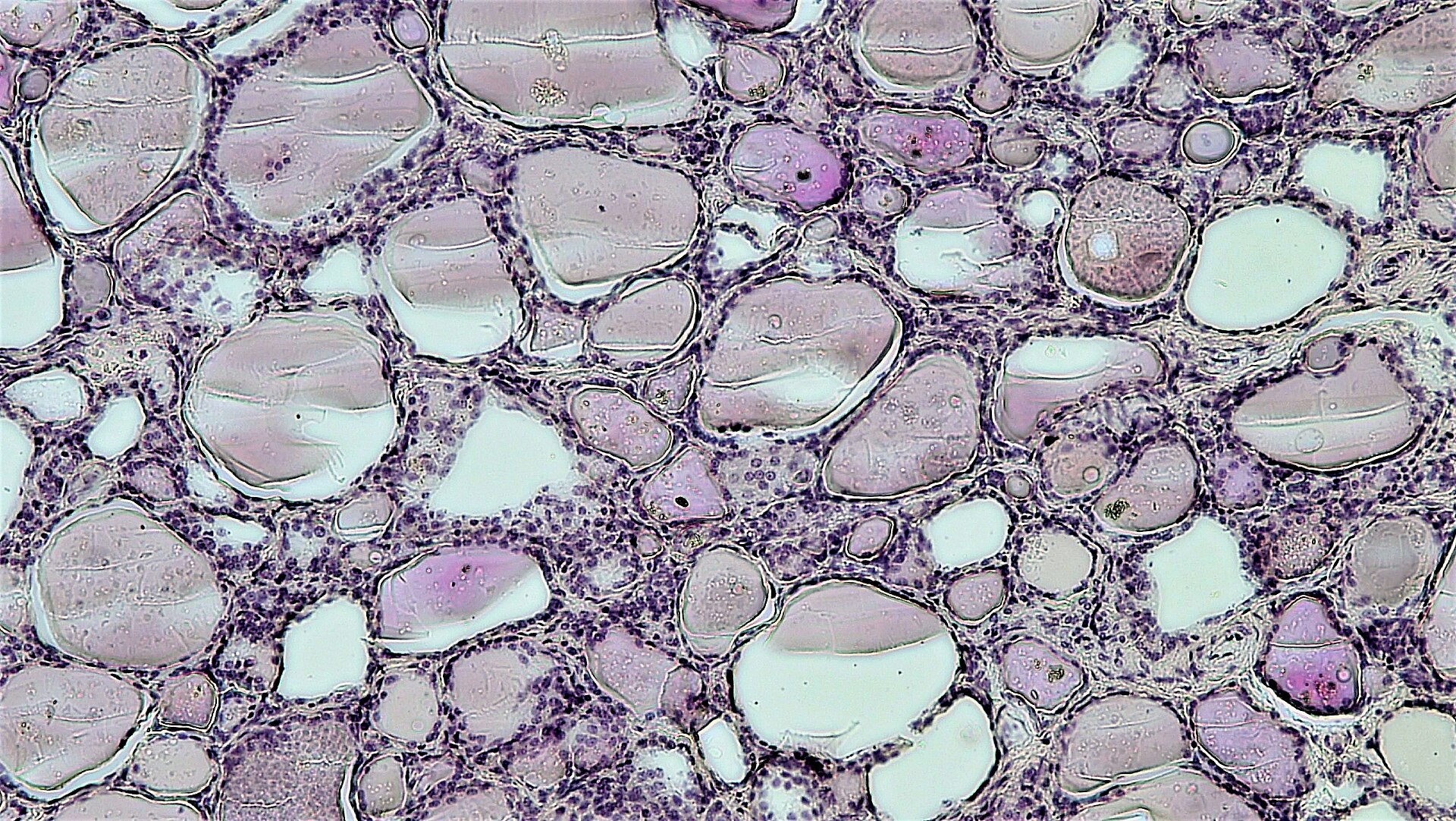
- Colloid Filled Lumens in Human Thyroid Gland (32546734627).jpg, by Berkshire Community College Bioscience Image Library (CC0, via wikimedia-commons): source
- The Central or Pancreatic Duct in the Human Pancreas (32757252487).jpg, by Berkshire Community College Bioscience Image Library (CC0, via wikimedia-commons): source
More on Liraglutide
Open the hub


Do GLP-1 drugs work the same for everyone? Pooled trial data weigh in
Liraglutide · News