Semaglutide beyond weight: new evidence on liver, knees and safety
News · Semaglutide
A European MASH guidance, a knee osteoarthritis review and a rare case report show where semaglutide research stands beyond weight loss.
Most semaglutide headlines are about weight. Three papers published this year look elsewhere: a joint European guidance on a form of fatty liver disease, a major review of new approaches to knee osteoarthritis, and a single case report of a rare bowel side effect. Together they show where the evidence beyond weight loss is firming up and where it is still thin.
Key takeaways
- Three European medical societies have jointly published guidance on when semaglutide or resmetirom may be considered for adults with MASH, a liver disease linked to metabolic health, who have moderate-to-advanced liver scarring but not cirrhosis [1].
- The same guidance says neither drug should be used to target MASH in people with cirrhosis until liver-related benefits are shown. Studies of long-term liver outcomes are still under way [1].
- A review in Nature Reviews Rheumatology names semaglutide as the first incretin-based therapy to show substantial benefits for knee osteoarthritis pain and function. It groups it with symptom-focused approaches, not with drugs that alter the disease [2].
- A case report describes ischemic colitis in one woman taking oral semaglutide. It came back when the drug was restarted. As a single case, it cannot show how often this happens [3].
The liver: a joint European guidance on MASH
Metabolic dysfunction-associated steatotic liver disease (MASLD), and its inflammatory form, steatohepatitis (MASH), carry a risk of heart and metabolic complications. They also carry a risk of major adverse liver-related outcomes, including cirrhosis, liver cancer and liver transplantation [1].
What kind of evidence: a practice guideline issued jointly by EASL, EASD and EASO, the European societies for liver disease, diabetes and obesity. It followed regulatory approval of resmetirom and semaglutide for MASH [1]. It is not a new trial. It turns existing evidence into recommendations on choosing candidates, starting therapy, monitoring and stopping [1].
What it says:
- Non-invasive tests of liver scarring can replace liver biopsy to identify adults at high risk of liver-related outcomes. These include elastography, which measures liver stiffness, and the enhanced liver fibrosis (ELF) blood score [1].
- Drug therapy is recommended for adults with MASH who do not have cirrhosis and who have fibrosis stage 2 or 3, judged by non-invasive tests or biopsy. It should come alongside structured lifestyle intervention and good management of other conditions [1].
- The choice between the two drugs should be individual. It should take account of the person’s preferences, potential risks, and their heart, kidney and metabolic profile [1].
- Semaglutide, a glucagon-like peptide-1 receptor agonist (GLP-1RA), may be preferred in adults with obesity or type 2 diabetes, or with established cardiovascular disease or high cardiovascular risk, because of its cardiometabolic benefits [1]. Resmetirom may be prioritised in people without obesity, or those already receiving or unable to tolerate GLP-1RAs [1].
- The guidance calls for structured monitoring. This includes checks on nutrition and sarcopenia (loss of muscle mass and strength) in people on semaglutide, and repeat non-invasive fibrosis tests to judge response [1].
Limits: a guideline is only as strong as the evidence behind it, and the abstract does not report the trials, their sizes or their durations. The authors note that ongoing studies are still testing whether either drug reduces major liver outcomes over the long term [1]. In adults with MASH cirrhosis, both drugs appear safe, but the guidance says they should not be used to target MASH until further data establish liver-related benefits [1].
The knee: semaglutide in a review of emerging osteoarthritis therapies
What kind of evidence: a narrative review in Nature Reviews Rheumatology that surveys the treatment research landscape for knee osteoarthritis (OA) [2]. A review summarises other studies. It does not produce new data, and the abstract gives no patient numbers.
The background: knee OA is the most common form of osteoarthritis and a leading cause of chronic pain and disability worldwide [2]. Its growing burden is driven mainly by ageing and obesity, and it is associated with major societal costs and higher cardiovascular mortality [2]. The authors describe it as a varied disease of the whole joint. It involves mechanical, metabolic, inflammatory, bone-and-cartilage, and nerve-and-blood-vessel processes [2]. They argue this complexity helps explain why existing painkillers work only modestly, and why efforts to develop disease-modifying OA drugs have repeatedly stalled [2].
Where semaglutide fits: among emerging approaches aimed at symptoms, the review lists incretin-based therapies. It describes semaglutide as the first to show substantial benefits for pain and function [2]. Other symptom-focused approaches include drugs that act on nerve growth factors, extended-release steroid injections into the joint, lubricating injections, and image-guided procedures on nerves and blood vessels [2].
The review also mentions GLP-1 receptor agonists given directly into the joint. It lists these with an investigational anabolic agent and an interleukin-1 receptor antagonist gene therapy as treatments that have shown encouraging signals [2]. By contrast, mesenchymal stromal cell therapies have so far shown inconsistent results across phase III trials [2].
Limits: the abstract does not describe the semaglutide studies behind the review’s conclusion, such as their design, size, duration or comparison groups. It also does not say whether the pain benefits can be separated from weight loss [2]. “Encouraging signals” for joint-injected GLP-1 receptor agonists marks early-stage work. The abstract does not say whether that work was in animals or people, so it should not be read as a human result [2].
Safety: a rare case of ischemic colitis
What kind of evidence: a single case report (n = 1) [3]. Ischemic colitis is inflammation of the colon caused by reduced blood flow.
What happened: a 46-year-old woman taking oral semaglutide for weight loss had three episodes of abdominal pain and rectal bleeding. Each one was linked in time to taking the drug [3]. The third episode followed reintroduction of semaglutide. CT scanning, rectosigmoidoscopy (a camera exam of the lower bowel) and tissue samples confirmed ischemic colitis [3]. After the drug was stopped for good, her symptoms resolved completely, with no further recurrence [3].
The authors judge the link to be a probable cause. They base this on the timing, the improvement after stopping the drug, and the recurrence when it was restarted [3]. They describe ischemic colitis linked to GLP-1 receptor agonists as exceptionally rare, with only a few cases in the literature [3].
Limits: one case cannot show how common this reaction is, who might be at higher risk, or whether the drug definitely caused it. The recurrence on restarting does strengthen the case for a link. Case reports are useful mainly as signals that larger safety studies can follow up.
Reading the three together
These papers sit at very different levels of evidence. The liver guidance builds on drug approvals and turns them into clinical recommendations, while flagging that long-term outcome data are pending [1]. The knee review summarises a fast-moving field in which semaglutide is one of several candidates, framed around symptoms rather than changes to the joint [2]. The case report is a single observation that adds a rare possible harm to the picture [3]. None of them, on their own, settles the question of benefit and risk in any of these areas.
What we still don’t know
- Liver outcomes: whether semaglutide lowers rates of cirrhosis, liver cancer or transplantation in MASH is still being studied [1].
- Cirrhosis: whether there is any liver-related benefit once cirrhosis has developed has not been established [1].
- Knee mechanism: the review’s abstract does not say how much of the reported pain and function benefit relates to weight loss and how much to other effects [2].
- Joint structure: semaglutide is listed among symptom-focused approaches. Whether it changes the course of the joint disease itself is not shown [2].
- Joint-injected GLP-1 drugs: these remain at the “encouraging signal” stage, without published evidence of benefit in people described in the abstract [2].
- Rare harms: how often ischemic colitis occurs with semaglutide, and in whom, cannot be answered by a single case [3].
References
- EASL-EASD-EASO guidance on the use of resmetirom and semaglutide as MASH-targeted therapy. Journal of Hepatology (2026). doi:10.1016/j.jhep.2026.08.028
- Emerging therapies for knee osteoarthritis. Nature Reviews Rheumatology (2026). doi:10.1038/s41584-026-01441-y
- Ischemic colitis associated with oral semaglutide with recurrence upon rechallenge. Revista Española de Enfermedades Digestivas (2026). doi:10.17235/reed.2026.12187/2026
Image credits
Free to use (CC0 / public domain); credited as a courtesy.
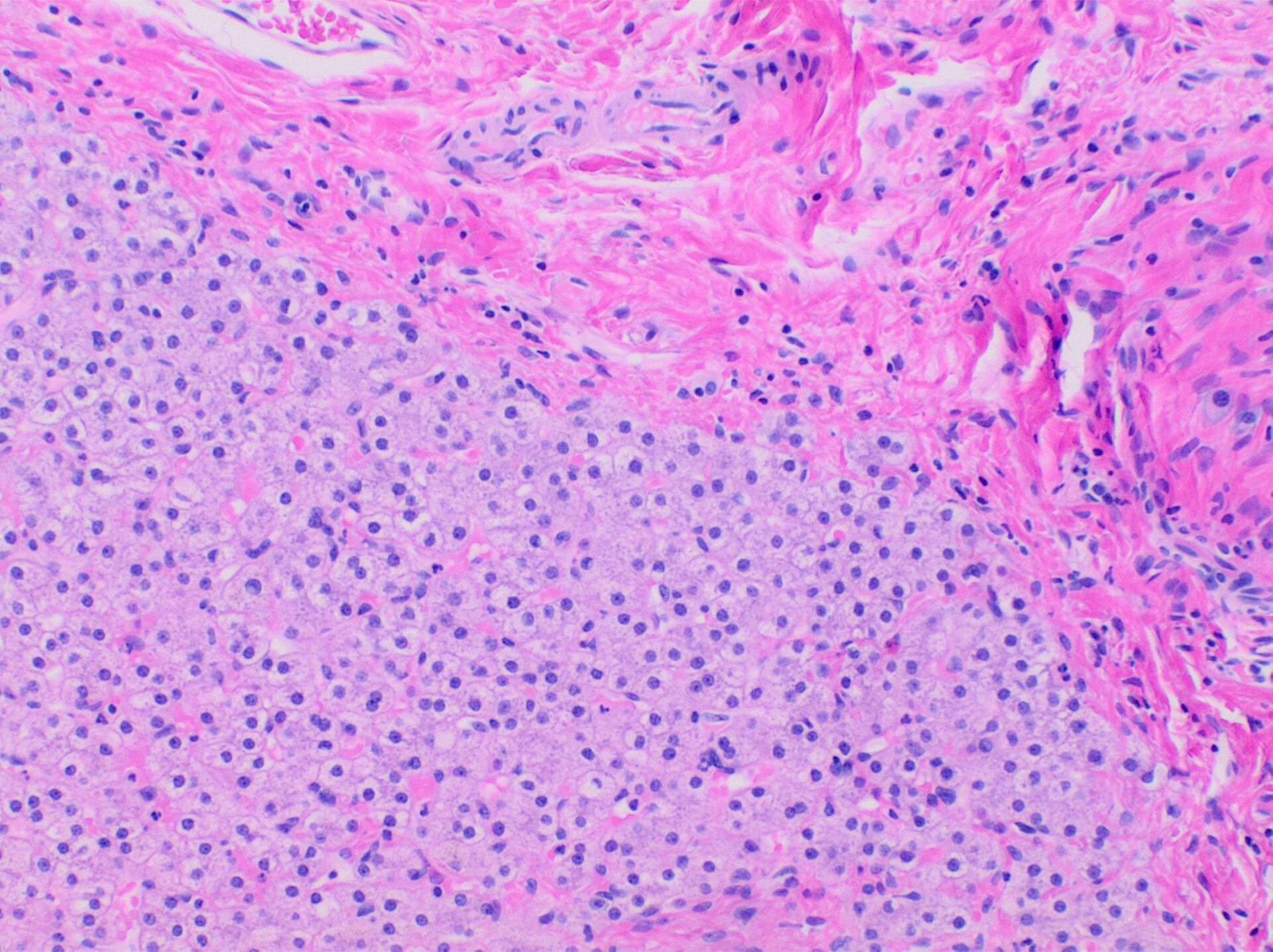
- Histology of liver tissue from a gallbladder resection.jpg, by Mikael Häggström, M.D. Author info – Reusing images- Conflicts of interest: None
Mikael Häggström, M.D.Consent note: Consent from the patient or patient’s relatives is regarded as redundant, because of absence of identifiable features (List of HIPAA identifiers) in the media and case information (See also HIPAA case reports guidance). (CC0, via wikimedia-commons): source
More on Semaglutide
Open the hub
Semaglutide safety by kidney function: trial data vs. drug reports
Semaglutide · News
Six months of keeping a research journal (demo)
Semaglutide · Member story

Inside the kidney: what a semaglutide biopsy trial did and didn’t find
Semaglutide · News